
Breast Milk Storage Guide: Safe Practices for New Moms
By Teddyy Editorial Team | Last Updated: April 23, 2026
Key Takeaways
- Sonia was overjoyed, cradling her little one in her arms and watching her tiny tot grow stronger with every drop of nourishment.
- Now, you must be wondering how long breast milk can be stored for.
- Before expressing or handling breast milk, wash your hands properly with soap and water.
- In order to properly label and organise stored milk, use a smudge-proof marker to tag each container with the date the milk was expressed and the amount of milk.
- Let’s explore some ways to safely thaw and warm stored breast milk.
Introduction
Proper breast milk storage ensures your baby gets the full nutritional benefits of expressed milk while keeping it safe and fresh.
Sonia was overjoyed, cradling her little one in her arms and watching her tiny tot grow stronger with every drop of nourishment. During this remarkable journey of breastfeeding, she discovered the magic of expressing and storing breast milk—a lifeline for those moments when she is away from her baby or needs a break.
The journey of motherhood is a beautiful experience, and one of its significant parts is breastfeeding. As your breast milk is a precious treasure—a gift for your baby that you can’t always be with, understanding its proper storage is crucial for preserving its freshness and ensuring its nutritional value for your baby. In this guide, we will explore how to store mother’s milk safely, including tips and dos & don’ts of breast milk storage.
How Long Can Breast Milk Be Stored
Now, you must be wondering how long breast milk can be stored for. Well, breast milk can be stored for different durations, depending on the storage method:
✅ Room Temperature (Below 25°C): Up to 6 hours
✅ Cooler (With ice packs): Up to 24 hours
✅ Refrigerator (Below 4°C): Up to 5 days
✅ Freezer: Up to 2 weeks in the regular freezer, or up to 6 months in a deep freezer.
✅ Deep Freezer (-18°C or lower): Up to 6 months or even 12 months.
Best Containers for Storing Breast Milk
Before expressing or handling breast milk, wash your hands properly with soap and water. Storing the expressed milk in a clean, capped food-grade glass container is recommended. You can also use a hard plastic, BPA-free container. Plastic bags especially designed for breastfeeding milk storage can also be used.
However, storing breast milk in disposable bottle liners or plastic bags made for general household use is not advised.
Tips for Properly Labelling and Organising Stored Milk
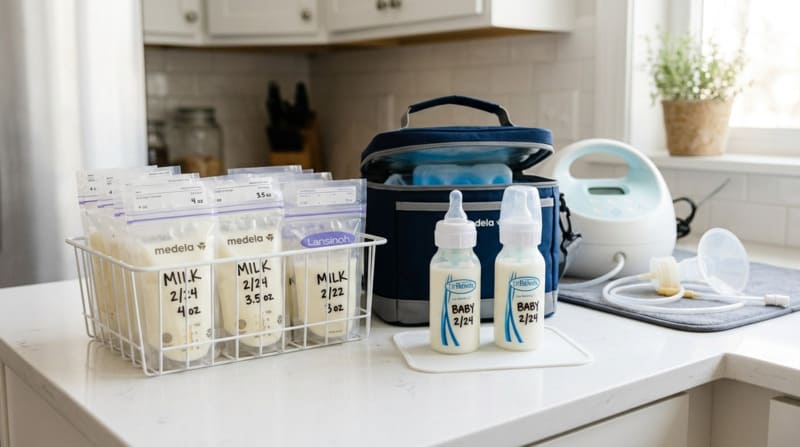
In order to properly label and organise stored milk, use a smudge-proof marker to tag each container with the date the milk was expressed and the amount of milk. It is recommended to utilise the oldest milk first to avoid expired or spoiled milk. So, here are the detailed tips for properly labelling and organising stored milk.
Tips for Labelling:
✅ Provide the date and time the milk was expressed.
✅ Write down the amount of milk in each container.
✅ If storing at a childcare facility, don’t forget to add the baby’s name.
✅ Use waterproof labels or smudge-proof markers for long-lasting tagging.
Tips for How Breast Milk is Stored:
✅ Use clean, capped, food-grade glass or plastic containers to store mother’s milk.
✅ Don’t use disposable bottle liners or plastic bags.
✅ Store milk in small quantities (2-4 ounces) to avoid wasting unused milk.
✅ Freeze flat to optimise freezer space and ensure freezing.
✅ For constant temperature, store in the back of the freezer, not the door
Tips for Organising:
✅ Use the oldest storage milk first to avoid spoilage.
✅ Using freezer organisers or bins is a practical approach to keep milk separate and organised.
✅ Keep a pumping record to track the milk supply.
General Tips to Store Mother’s Milk:
✅ Wash your hands before expressing or handling milk.
✅ Close the containers tightly to prevent the risk of spills and contamination, and maintain them fresh.
✅ Do not refreeze thawed breast milk.
✅ Thawing breast milk in the refrigerator overnight is a safe and recommended method.
✅ Microwaving milk is generally not recommended, as it can destroy essential nutrients and form hot spots.
How to Safely Thaw and Warm Stored Breast Milk
Let’s explore some ways to safely thaw and warm stored breast milk.
✅ Thaw the oldest milk first and use it within 24 hours.
✅ Put the frozen container in the refrigerator the night before you aim to use it.
✅ You can also warm the milk by placing the container under lukewarm running water or in a bowl of lukewarm waer.
✅ Don’t microwave the frozen bottle or heat it quickly on the stove, as it can destroy the milk’s essential nutrients and create hot spots.
✅ Never refreeze thawed breast milk. And, discard the thawed milk if not used within 24 hours.
Do’s and Don’ts of Breast Milk Storage
Now let’s understand the do’s and don’ts of breast milk storage.
| Do’s of How to Preserve Breast Milk | Don’ts of Breastfeeding Milk Storage |
| Proper Containers: Storing breast milk in clean, capped glass or hard plastic, BPA-free containers is recommended. Additionally, you can use plastic bags especially designed for breast milk storage. | Don’t Use Unsafe Containers: Avoid using disposable bottle liners or general household plastic bags. |
| Labelling: Each container is clearly labelled with the date the milk was expressed. | Don’t Overfill Storage Bags: It is essential to allow for expansion as the milk freezes to avoid cracking or bulging of the container. |
| Cooling: It is crucial to cool breast milk quickly after expressing. | Don’t Store Bags Incorrectly: Prevent storing bags on their sides, against other items or the freezer door. |
| Freezing: Store small amounts (2-4 ounces) to avoid waste. Leave about 1-1.5 inches of space at the top of the container for expansion before freezing. | Don’t Refreeze Thawed Milk: Once thawed, milk should not be refrozen. |
| Thawing: Thaw milk under lukewarm water or overnight in the refrigerator. | Don’t Microwave Milk: Avoid microwaving as it can create hot spots and destroy nutrients. |
| Use Within Time Limits: Use the milk within 24 hours after thawing, and utilise leftover milk within 2 hours after feeding. | Don’t Add Warm Milk to Refrigerated Milk: Let the fresh milk cool before combining with refrigerated milk. |
| Cleanliness: Wash your hands properly before expressing or handling milk. | Don’t Store in the Refrigerator Door: Avoid storing your breast milk in the refrigerator door, as the door experiences temperature fluctuations. |
| Sanitise Pump Parts: Clean and sterilise breast pump parts after each use. | Don’t Use Old Milk: Throw out the milk after the recommended storage time. |
| Refrigeration: Always store milk in the coldest part of the refrigerator, away from the door. | Don’t Wash Pump Parts Incorrectly: Washing pump parts in a clean basin with soap and water is recommended, not directly in the sink. |
Storage Times for Different Locations at a Glance
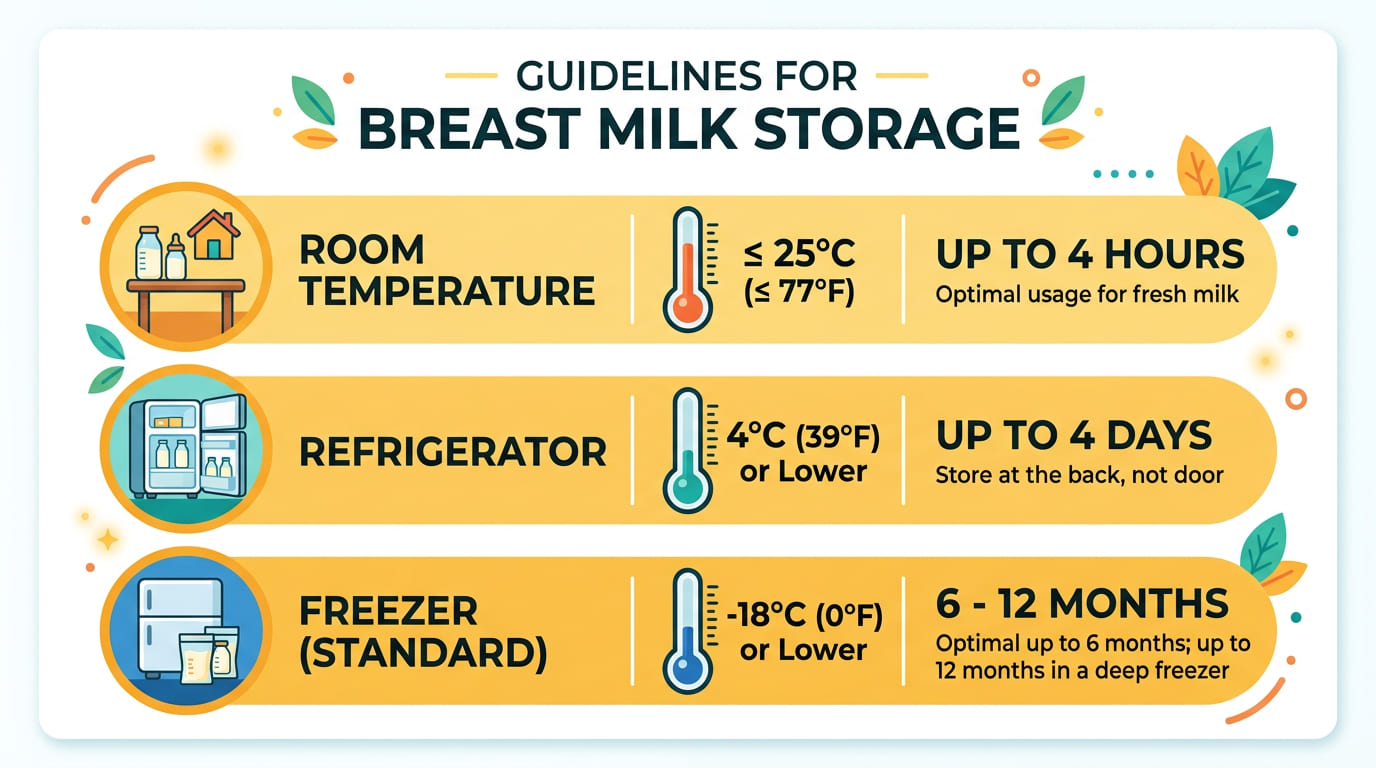
Freshly expressed breast milk stays safe at room temperature (up to 25°C/77°F) for about 4 hours, in a cool insulated bag with ice packs for around 24 hours, in the back of the refrigerator (≤4°C/39°F) for up to 4 days, and in a deep freezer (-18°C/0°F or lower) for up to 6 months for best quality and 12 months at the outer limit. Always go by the earliest time your milk has been stored — once milk has been at room temperature for hours, it cannot be put back in the fridge or freezer to “extend” the clock. Mark the time the milk was pumped, not the time it was stored, to avoid confusion.
How to Combine Milk from Different Pumping Sessions
If you want to combine breast milk pumped at different times in the same day, chill the freshly pumped milk in the fridge for at least an hour first, then pour it into the older container. Never add warm or room-temperature milk directly to chilled or frozen milk — the temperature shift can warm the older batch into an unsafe zone. Always label the combined container with the date and time of the oldest portion, since that determines how long the mixture is safe to use. Keep daily batches in small 60–120 ml portions so you defrost only what your baby will finish in one feed.
Signs That Stored Breast Milk Has Gone Bad
It is normal for stored breast milk to separate into a creamy top layer and a watery bottom layer — a gentle swirl mixes it back. However, if the milk smells sour or rancid even after warming, looks chunky or curdled, or your baby refuses it consistently after one sip, discard it. Some moms also have high lipase activity, which makes thawed milk taste soapy or metallic even though it is safe; if your baby will not take it, scalding fresh milk before storing can help. Always taste a tiny drop yourself if you are unsure before offering it to your baby.
Travelling and Power Cut Tips for Pumped Milk
For travel, pack pumped milk in an insulated cooler bag with frozen gel packs surrounding the bottles, and aim to refrigerate or freeze again within 24 hours. On flights, milk is allowed in carry-on luggage in reasonable quantities even without your baby — declare it at security. During power cuts, keep the freezer door shut; a full freezer holds temperature for around 48 hours and a half-full one for about 24 hours. If milk has fully thawed but is still cold and was used within 24 hours, it can be refrigerated and given to baby; if warm, discard it.
Final Words
Properly expressing, organising, and storing are crucial for maintaining the nutritional value and safety of breast milk. Follow best practices to store mother’s milk, ensuring that the milk remains safe and nutrient-rich for feeding. Remember, every drop of breast milk provides essential nutrients, antibodies, and bioactive factors to your little one, supporting their growth, immunity, and overall well-being.
References & Sources
You May Also Like




Frequently Asked Questions
What is the safest way to store breast milk?
In order to store breast milk, the safest way is to use breast milk storage bags or clean, food-grade containers, following the recommended storage times. You can store freshly expressed milk at room temperature for up to 4 hours, in the refrigerator for up to 4 days, and in the freezer for about 6 months.
What is the 5 rule for breast milk storage?
The ‘5-5-5’ rule for breast milk storage suggests that you use the milk within five hours at room temperature, five days in the refrigerator, and five months in the freezer. Remember, these are just guidelines. The actual timeframes can vary based on the specific milk and storage settings.
What is the 4 4 4 rule for breast milk?
The ‘4 4 4 rule’ for breast milk storage is a simple guideline to remember for how long breast milk can be stored at different temperatures – 4 hours at room temperature, 4 days in the refrigerator, and up to 4 months in the freezer.
What is the 3-3-3 rule for breast milk?
The ‘3-3-3 rule’ for breastfeeding milk storage refers to a simple guide for feeding at least every three hours, feeding at least three minutes on each breast, and being satisfied for at least three hours after feeding.