
The Safest and Most Effective Pregnancy Exercises for the First Trimester
By Teddyy Editorial Team | Last Updated: April 23, 2026
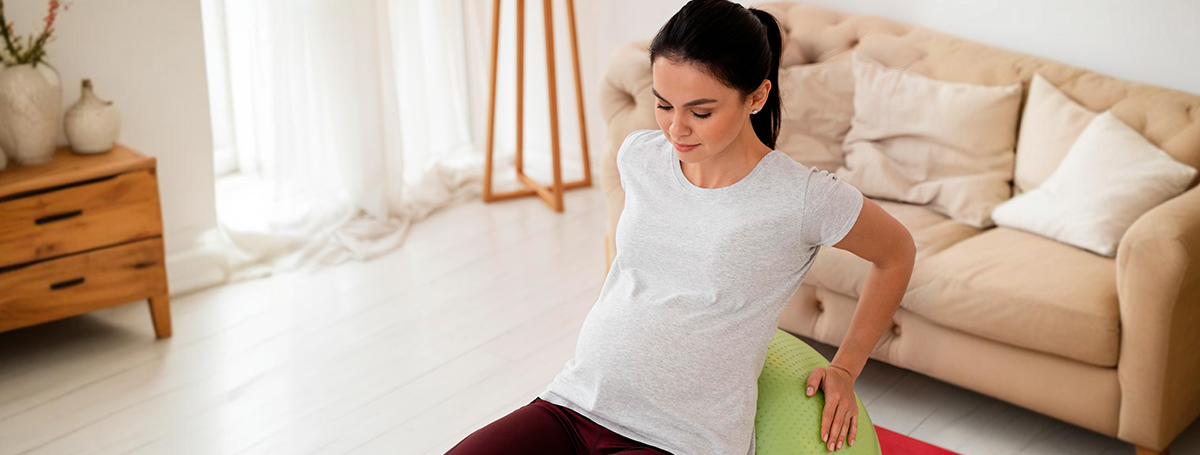
Pregnancy exercises play a vital role in maintaining your health and preparing your body for childbirth. Choosing the right pregnancy exercises during your first trimester helps reduce common discomforts like fatigue, nausea, and back pain while boosting your mood and energy levels.
Pregnant women should not work out. It will harm the baby.” You may hear such pieces of advice throughout your pregnancy journey. While they may come from a place of love and concern, not everything you hear is true. And when it comes to pregnancy, it is better to make well-informed decisions.
The myth that pregnant women should not exercise has been around for too long, and it is high time to put that to rest. If you do not have any specific instructions from your doctor on not exercising, then it is perfectly alright to add safe exercises for pregnant women into your routine. Adding exercises daily during your pregnancy can prove to be very beneficial.
Key Takeaways
- If you have been relatively active before your pregnancy, you need not stop it now.
- Pregnancy exercises in the first trimester that are easy and safe to follow include:.
- Some exercises and activities are hazardous to both you and your growing baby.
- If you have been a physically active person prior to pregnancy and have been doing heavy workouts, you can modify your exercises to suit your pregnancy journey better.
- While doing your 1st trimester exercises, keep a close watch on how your body feels.
The Importance of Staying Active in the First Trimester
If you have been relatively active before your pregnancy, you need not stop it now.
Being active with low-impact yet practical pregnancy exercises will be highly beneficial in many ways during your pregnancy and postpartum. Some benefits of staying physically active during pregnancy include:
- Reduced risk of pre-eclampsia (a condition that causes high blood pressure and other complications)
- Maintained body weight and flexibility
- Improvement in mood and sleep
- Lesser risk of gestational diabetes and hypertension
- Reduction in stress and anxiety
- Lesser risk of constipation and back pain
- Lesser delivery complications
- Reduced occurrence of postpartum depression
You should discuss the pregnancy exercises in the first trimester with your consulting doctor to confirm whether it is entirely safe for you to do. Only in a few cases with some pregnancy-related complications or contradictions is it not advisable.
Safe Exercises to Try During the First Trimester
Pregnancy exercises in the first trimester that are easy and safe to follow include:
- Walking
- Swimming
- Water aerobics
- Cycling (Stationary is even safer)
- Climbing stairs (Average pace)
- Using an Elliptical machine
Activities such as yoga, pilates, and Kegel exercises can also be included after a professional consultation and done under supervision if learning them for the first time. High-impact exercises like weightlifting, aerobics, running, etc., should be done only after a consultation with your doctor and under supervision.
Exercises to Avoid During the First Trimester
Some exercises and activities are hazardous to both you and your growing baby. So, stay away from these activities during your first trimester of pregnancy:
- Horse riding
- Skiing
- Scuba Diving
- Trampoline
- Basketball, Volleyball, Football and such high-impact contact sports
- Planks, crunches, push-ups and sit-ups
Also, exercises that are to be avoided are:
- Those that put too much pressure on your pelvic floor
- Exercises that involve holding your breath
- Workouts that involve you lying on your back
- Activities involving bending a lot, back-bending, twisting, bounding, jumping, hopping, stretching, or skipping
- Exercises that have you lying on your right side for long periods
- Activities that require sprinting, agility or a lot of running
- Exercises that involve deep knee bends, double leg raises, head-stands and squats
- Hot Yoga
Exercising during hot weather is also not advisable for pregnant women. Sticking to the safe pregnancy exercises discussed before and doing them under safe conditions must be your priority.
Tips for Modifying Your Exercise Routine
If you have been a physically active person prior to pregnancy and have been doing heavy workouts, you can modify your exercises to suit your pregnancy journey better. Keeping in mind the little baby growing inside you, you must change your physical workouts.
- Pregnancy exercises in the first trimester should not be too heavy or put a lot of stress on your body. Do the safe exercises discussed in the previous sections.
- Ensure you start with a warm-up before your exercise routine. Once done with the workout, you should also do a cool-down routine.
- For the final five minutes of your workout, switch to a slower pace and stretch out all your tighter muscles.
- Hydrate yourself well. Keep healthy snacks with you in case you need an instant energy boost.
- Heart rate should be optimally within 110-120, and another way to keep that in check is to work out at a pace where you can still have a normal conversation.
Listening to Your Body: When to Stop or Seek Medical Advice
While doing your 1st trimester exercises, keep a close watch on how your body feels. Whatever exercise or activity you do, do it at a comfortable pace. Switch pace or take breaks if it gets too overwhelming at any point. Wear comfortable clothing and shoes during the workout sessions.
It is necessary to stop exercising immediately if you feel any discomfort in the middle of a workout, such as:
- Difficulty breathing
- Dehydration
- Nausea
- Dizziness
- Headache
- Feeling too hot
- An elevated heart rate
It is highly essential to seek immediate medical advice if you experience any of these:
- Chest congestion or pain
- Loss of consciousness
- Pelvic or abdominal pain
- Vomiting or diarrhoea
- Increased or slow pulse rate
- Calf pain/swelling
- Vaginal discharge or bleeding
How Much Exercise Is Safe in the First Trimester?
The American College of Obstetricians and Gynecologists recommends 150 minutes of moderate exercise per week — about 30 minutes, 5 days a week. If you exercised regularly before pregnancy, you can usually continue your routine with mild adjustments. If you were sedentary, start with 10–15 minute walks and build up gradually. Listen to your body: nausea, fatigue, and dizziness are common in the first trimester and a clear signal to rest. Quality over quantity matters more than ever now.
Best Beginner-Friendly Exercises for Week 1–12
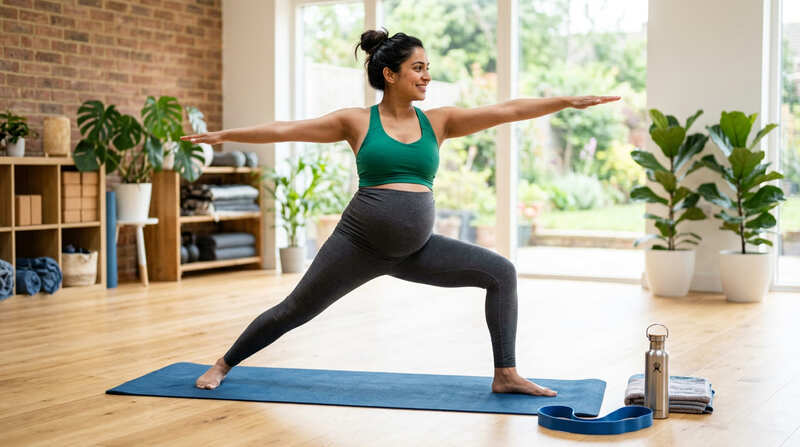
Walking is the gold standard — low impact, no equipment, easy to scale. Prenatal yoga (cat-cow, child’s pose modified, gentle warrior poses) builds strength and flexibility while easing back pain. Swimming and water aerobics support your weight and ease joint stress. A stationary bike (upright, not recumbent until later) gives a safe cardio workout. Pelvic floor exercises (Kegels) — start now, your body will thank you postpartum. Light resistance training with 1–3 kg weights maintains muscle tone.
Heart Rate Guidelines for Pregnancy
The old “do not exceed 140 bpm” rule has been retired. Today’s guideline is the “talk test”: you should be able to hold a conversation while exercising. If you can sing, you can probably push a little harder; if you cannot speak in full sentences, slow down. Use a heart rate monitor only if your doctor recommends it. Aim for 60–80% of your maximum effort — moderate intensity, not all-out effort. Always warm up for 5 minutes and cool down for 5 minutes.
What Happens If You Were Not Active Before Pregnancy
Pregnancy is not the time to start a hard fitness program, but it is the perfect time to begin gentle, regular movement. Start with 10-minute walks twice daily. Add 5 minutes of stretching morning and night. Try a beginner prenatal yoga video once a week. After two weeks, increase to 20-minute walks. By week 8, aim for 30-minute walks daily plus 2 yoga sessions per week. Even small amounts of movement help with energy, mood, sleep, and labour stamina.
Hydration and Nutrition Around Workouts
Drink 500 ml of water 2 hours before exercise, sip during, and another 500 ml after. Eat a small carbohydrate snack 30–60 minutes before workouts (banana, toast with peanut butter, oats). After exercise, refuel within 60 minutes with protein and carbs (Greek yogurt with fruit, hummus with whole-grain crackers). Avoid exercising on an empty stomach — first-trimester blood sugar drops fast. Skip sports drinks; plain water plus a fruit is enough for moderate workouts.
Warning Signs to Stop Exercising Immediately
Stop and call your doctor if you experience: vaginal bleeding or fluid leakage, dizziness or feeling faint, chest pain or rapid irregular heartbeat, severe headache or sudden visual changes, calf pain or swelling, contractions that do not stop with rest, or decreased baby movement (after week 20). Mild breathlessness during effort is normal; struggling to catch your breath at rest is not. Always trust your body — pregnancy is not the time to push through pain.
Exercises Doctors Specifically Warn Against
Avoid contact sports (basketball, football, hockey), activities with fall risk (skiing, horseback riding, gymnastics), scuba diving (can harm baby), hot yoga and Bikram (overheating risk), exercises lying flat on your back after week 12, anything with sudden direction changes, and high-altitude workouts above 6,000 feet if you are not acclimated. Skip exercises that involve breath holding (heavy weight lifting), as they can spike blood pressure. When in doubt, ask your obstetrician before starting any new activity.
Conclusion:
While adding first-trimester exercises to your daily routine during pregnancy, it is best to remember the do’s and don’ts we have discussed so far. It is also necessary to keep your doctor in the loop about your exercise regime, as they can give the best input per your medical condition and your baby’s growth.
Postpartum, you will face many changes in your body, so make the most of your precious pregnancy journey and cherish it. You can be prepared for the arrival of your little bundle of joy by purchasing our Teddyy Diapers in advance and shed the worries of diaper leaks and rashes. There is a wide range of tape-style and pant-style diapers, nappy pads, baby wipes, and changing mats to make your baby feel the most comfortable and clean. For your post-delivery exercises, check this blog to learn more.
For safe exercise guidelines during pregnancy, visit the ACOG exercise during pregnancy guide.
More helpful articles:
For evidence-based guidance on pregnancy exercises, visit the American College of Obstetricians and Gynecologists (ACOG) website.
References & Sources
You May Also Like




Frequently Asked Questions
Can a pregnant woman exercise in the first trimester?
Yes, unless their doctor has specifically advised them not to.
What to avoid in the first trimester of pregnancy?
All exercises that require jumping, twisting, too much bending, back-bending, hopping, bounding, skipping, stretching, squatting, sprinting, knee-bending, head-stands, lying down for longer periods, and holding breath for a long time must be avoided.
Which trimester is safe for exercise?
All trimesters are safe for exercising; however, try to do comfortable exercises and don’t exert yourself too much.
Is jumping safe in the first trimester?
No, it is not advisable to do any jumping activities during your first trimester.